Cyprus Steps Up as India’s Strategic Gateway to the European Union

India and Cyprus have elevated their relationship to a Strategic Partnership following talks between Prime Minister Narendra Modi and Cyprus President Nikos Christodoulides in New Delhi, signalling a deliberate push to deepen India’s engagement with the European Union through a trusted Mediterranean partner. The upgrade comes as Cyprus holds the Presidency of the Council of the European Union, giving the move clear India–EU relevance at a pivotal moment for trade, connectivity and regulatory cooperation.

Strategic Partnership with a European Lens
According to India’s Ministry of External Affairs (MEA), the leaders agreed that the new Strategic Partnership will strengthen cooperation in trade and investment, defence and security, maritime and financial connectivity, technology and innovation, education, culture, mobility and India–EU engagement. Prime Minister Modi described the friendship between India and Cyprus as “strong and futuristic”, rooted in shared democratic values and the rule of law.
Cyprus is already among India’s top ten investors, and the Prime Minister noted that investment from Cyprus into India has nearly doubled in the past decade. He added that, with the India–European Union Free Trade Agreement creating new opportunities, both sides aim to double investment flows again over the next five years.
Cyprus as Bridge for India–EU Relations
The MEA has underlined that President Christodoulides’s 20–23 May 2026 State Visit is taking place less than a year after Prime Minister Modi’s “historic” visit to Cyprus in June 2025, and that it carries added significance because of Cyprus’ ongoing EU Council Presidency and the wider India–EU context. In his remarks, President Christodoulides said that both India–Cyprus and India–EU relations have made “leaps of progress” over the past year.
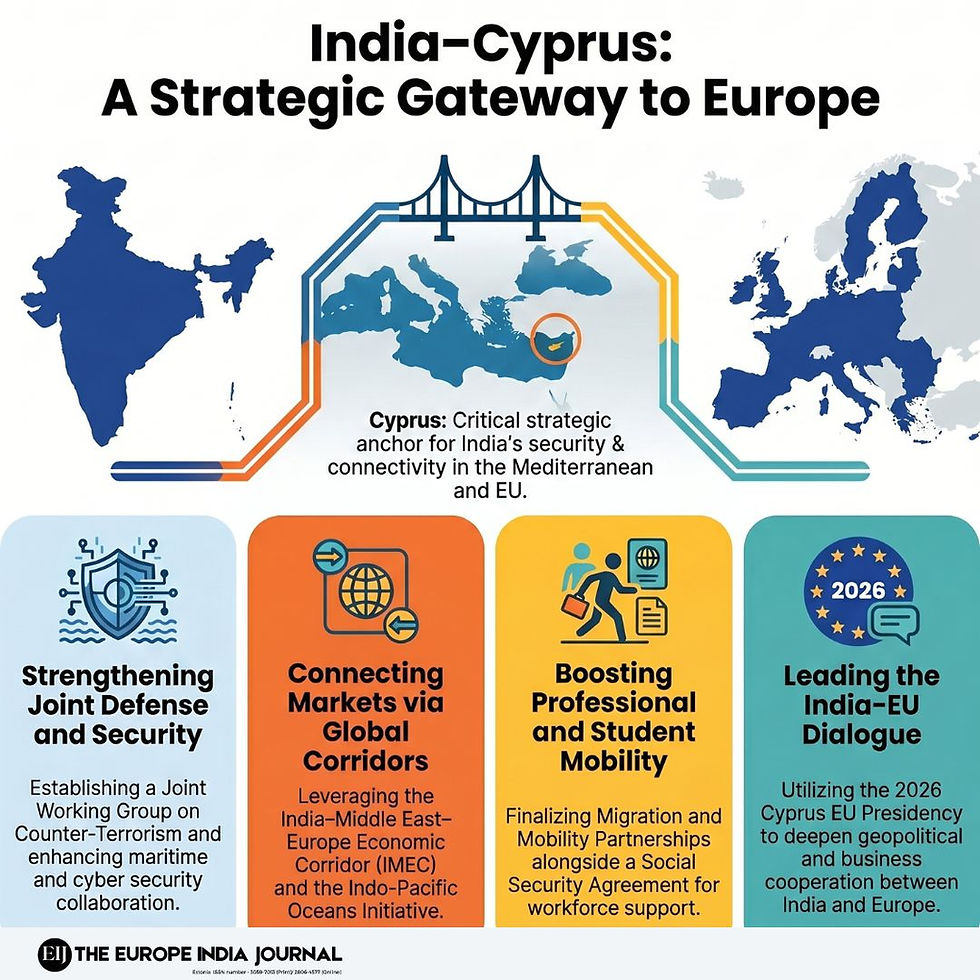
Cypriot and Indian statements during the visit highlighted Cyprus’ readiness to act as a reliable European bridge for India, including in the context of the India–Middle East–Europe Economic Corridor (IMEC), which both sides have publicly endorsed as a forward-looking connectivity initiative. This positions Nicosia as a potential facilitation hub for Indian business and policy engagement with the EU single market.
Connectivity, Security and People-to-People Focus
The leaders witnessed the exchange of several agreements, including on counter-terrorism cooperation, maritime security, diplomatic training, innovation, higher education and cultural collaboration, as well as the decision to establish a Joint Working Group on Counter-Terrorism. Prime Minister Modi noted plans to work together on cyber security, maritime security and counter-terrorism, and to leverage initiatives such as the Indo-Pacific Oceans Initiative and the India–Middle East–Europe Economic Corridor to enhance connectivity.
Both sides also agreed to work towards a comprehensive Migration and Mobility Partnership and a Social Security Agreement to support professionals and students, alongside new agreements in culture and higher education to deepen research and people-to-people exchanges. During his India visit, President Christodoulides paid homage at Rajghat and held interactions with business leaders in Mumbai on financial services, technology, innovation, shipping, connectivity and energy, reflecting the economic and people-centred thrust of the upgraded partnership.
In a related India–EU initiative, the Europe India Centre for Business and Industry (EICBI), a European Parliament-accredited and European Commission-registered geopolitical forum, jointly hosted a Special Policy & Business Dialogue in Ahmedabad with Water & Shark on 27 April 2026. The session focused on the Cyprus Presidency of the Council of the European Union and on strengthening EU–India cooperation. EICBI said the dialogue brought together stakeholders to discuss cooperation between India, Cyprus and the European Union.


Comments