EU-India Trade Agreement: Key Highlights of the Landmark Pact

The European Union and India have announced the successful conclusion of negotiations on a far‑reaching trade agreement, marking a significant step forward in their strategic partnership. The deal, finalised in January 2026 after talks were relaunched in 2022, is described by the European Commission as the largest trade agreement either side has ever concluded.
A landmark agreement between major economies
Together, the EU and India account for around a quarter of the world’s population – roughly two billion people – and about 25 per cent of global GDP. The agreement aims to remove trade barriers, simplify procedures and open new export opportunities, while strengthening economic security by diversifying supply chains. It is also expected to deepen political ties between the world’s two largest democracies.

Existing trade and projected gains
The EU and India already trade goods and services worth more than €180 billion a year, supporting close to 800,000 jobs in the EU alone. According to the European Commission’s impact estimates, the agreement could more than double EU annual goods exports to India by 2032, with an increase of about 107.6 per cent. Tariff cuts are central to this outcome: around 90 per cent of tariffs will be eliminated or reduced, with duty savings of roughly €4 billion per year for European exporters.
Access to a key growth market
The agreement gives EU companies privileged access to India, now the world’s most populous country and the fourth‑largest economy. With some 6,000 European firms already operating in India, the new rules are expected to support competitiveness and provide additional certainty across multiple sectors, from industry and services to agri‑food trade.
Protecting sensitive agricultural sectors
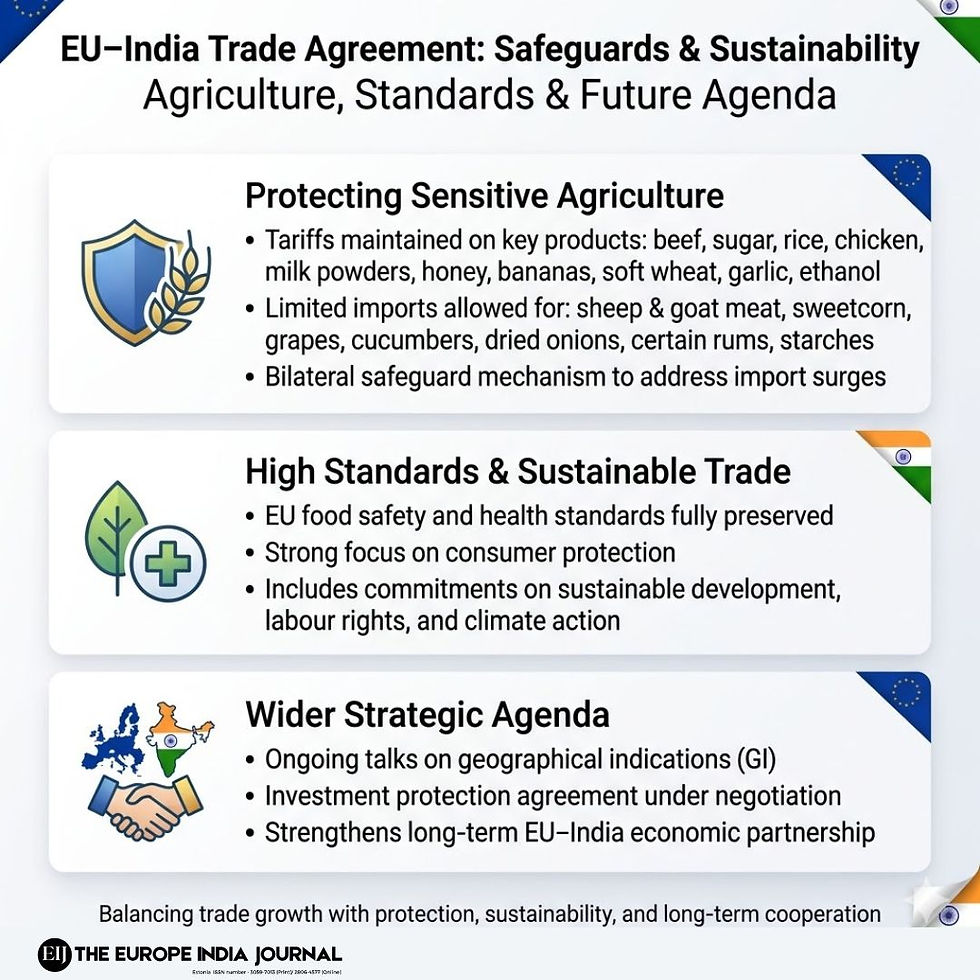
At the same time, the agreement includes safeguards for Europe’s sensitive farming sectors. Existing tariffs will be maintained on products such as beef, sugar, rice, chicken meat, milk powders, honey, bananas, soft wheat, garlic and ethanol. Only limited imports will be allowed for goods including sheep and goat meat, sweetcorn, grapes, cucumbers, dried onions, certain rums and starches, backed by a bilateral safeguard mechanism that allows action if imports cause difficulties.
High standards and sustainable trade
EU health and food safety standards will continue to apply in full, with the agreement designed to ensure that high levels of protection are preserved for European consumers. Beyond market access, the deal also contains provisions on sustainable development, labour rights and climate change, signalling a shared intention to align trade with wider environmental and social objectives.
Part of a wider negotiating agenda
The trade agreement forms part of a broader agenda between the EU and India. In parallel, the two sides are negotiating specific agreements on geographical indications and on investment protection to complement the main trade pillar.
This article is based solely on information officially published by the European Commission on the EU‑India trade agreement, available on the Commission’s trade webpages.


Comments