From Austrian Wine in Delhi to Indian Blankets in Europe: Member of European Parliament Anna Stürgkh on the Promise of the India EU Trade Partnership

The past year has tested the global order, challenging long-standing assumptions about trade liberalisation and cooperation. Yet, in this moment of uncertainty, the India-EU trade agreement offers a path forward. For India, it means deeper access to one of the world’s largest markets. For the EU, it reinforces ties with a dynamic and influential partner. For both, it is a chance to reaffirm our commitment to open, rules-based trade.
To the European Union, free trade has always been more than mere strategy; it is a cornerstone of the Union’s identity. When our biggest trading partner started to question this very principle, it was not just luck that we had major agreements, including this one, lined up.
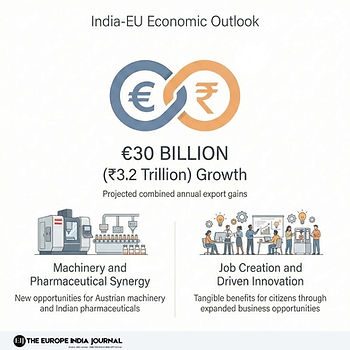
Behind it were many years of planning, negotiation and commitment to our core values. With our trading partners, the European Union has doubled, and in some cases even tripled, our volume of exports. Therefore, it comes as no surprise that for the India-EU free-trade agreement, the numbers tell a compelling story: the agreement is projected to generate €30 billion (₹3.2 trillion) in combined annual export gains.
From Austrian machinery to Indian pharmaceuticals, businesses on both sides will find new opportunities, creating jobs and driving innovation. This does not just send a message to other partners; it is policy that provides tangible benefits for citizens on both sides.
Not merely the exchange of goods, but the exchange of values and ideas is what excites those of us who support this agreement. When Austrians or other Europeans export their products to India, they export craftsmanship and quality.
Let us show the doubters of trade liberalisation what it can do for our people. Let us embrace rules-based free trade, innovation and shared success. As the world becomes less predictable, let us deliver on the promise of a better tomorrow. - Ms. Anna Stürgkh
I like to imagine an Indian couple winding down to a glass of Austrian wine on a hot summer night in Delhi, Mumbai or Kolkata. Likewise, Europeans will cosy up in handmade Indian blankets on cold winter days. A vast array of industries will profit, ranging from independent farms to titans of manufacturing on both sides.

The “mother of all deals”, as dubbed by the President of the European Commission, goes beyond just trade and economic benefits - it is a partnership between the world’s second and fourth largest democracies, a partnership that has the potential to pave the way for decades of friendship and collaboration.
Besides the deal, the security and defence partnership signed alongside the trade deal signals increasing trust. In a world where democratic values are under pressure, our cooperation sends a powerful message: democracies can, and must, work together to shape the future.
Just as we share democracy as a fundamental value, the agreement gives us the opportunity to work together on a whole range of issues. Trade agreements have the benefit of not only removing tariff barriers, but also establishing rules for fair trade that benefits both parties as well as external stakeholders.
On top of agricultural safeguards, food safety standards and reinforced rules of origin, both sides commit to climate action cooperation, with the EU providing India with financial support and guidance to decarbonise industry operations. United, we will form a zone of two billion people working towards common goals.
Let us show the doubters of trade liberalisation what it can do for our people. Let us embrace rules-based free trade, innovation and shared success. As the world becomes less predictable, let us deliver on the promise of a better tomorrow.
This article is written by
Ms. Anna Stürgkh
Member of European Parliament, Austria
Disclaimer
The views and opinions expressed in this article are those of the contributor and do not necessarily reflect the official policy, position, or editorial stance of EIJ. EIJ provides a platform for diverse perspectives and informed debate. Responsibility for the accuracy of facts and interpretations rests solely with the author.


Good points! The EP needs to be more openminded on trade agreements.