How Indian Companies Can Make the Best Use of the India–EU FTA

The India–EU FTA has rightly captured attention across business and policy circles. Access to one of the world’s most sophisticated markets is no small milestone. For Indian companies, this signals not just improved trade relations, but a long-term invitation to compete, collaborate, and scale globally.
Yet trade agreements don’t deliver success on announcement day. They create opportunity. What follows determines impact.

The real story of the India–EU deal will be written in execution.
For many businesses, especially mid-sized firms and MSMEs, the agreement is less a finish line and more a starting point.
European markets reward consistency, credibility, and compliance as much as competitiveness. This is not a drawback — it is a filter that favours prepared players. What the deal truly demands is readiness.
Standards Define Access, Not Just Tariffs
European buyers operate in a deeply regulated environment where product safety, sustainability, traceability, and quality assurance are foundational expectations.
Companies that already treat compliance as a strategic asset — not a regulatory burden — will move faster and build trust sooner.
Operational Discipline Becomes a Market Advantage
Clear documentation, structured processes, transparent supply chains, and repeatable quality are not optional in Europe. Businesses that have invested in formalising their operations will find that the EU market amplifies these strengths rather than exposing gaps.
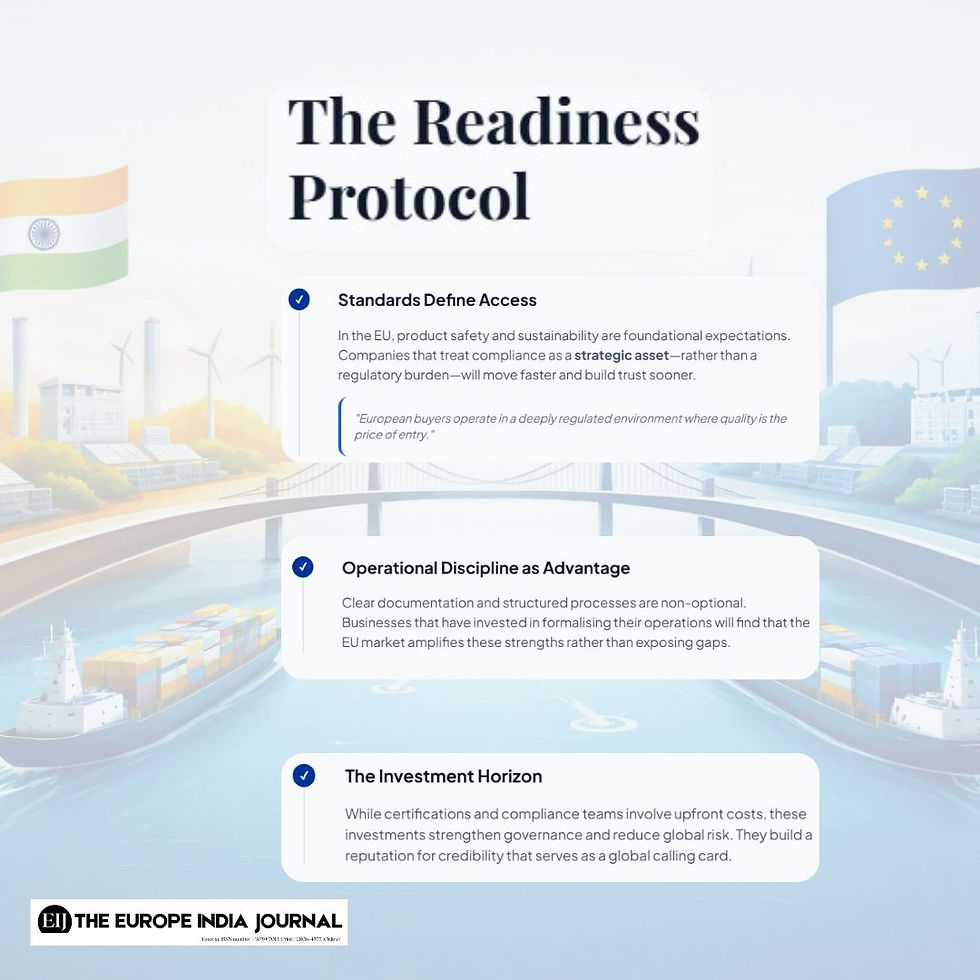
Upfront Investment Builds Long-Term Credibility
Certifications, ESG alignment, compliance teams, and digital systems do involve initial costs.
But these investments don’t serve just one market. They strengthen governance, reduce risk, and improve global credibility — benefits that extend well beyond Europe.
Preparation, Not Reaction, Creates Early Winners
The companies best positioned to benefit are not reacting to the deal; they have been building export readiness, regulatory literacy, and disciplined execution over time.
The agreement simply accelerates their momentum.This does not make the India–EU trade deal challenging. It makes it meaningful.


Comments