India and Bulgaria Push to Fast-Track European Union Trade Agreement

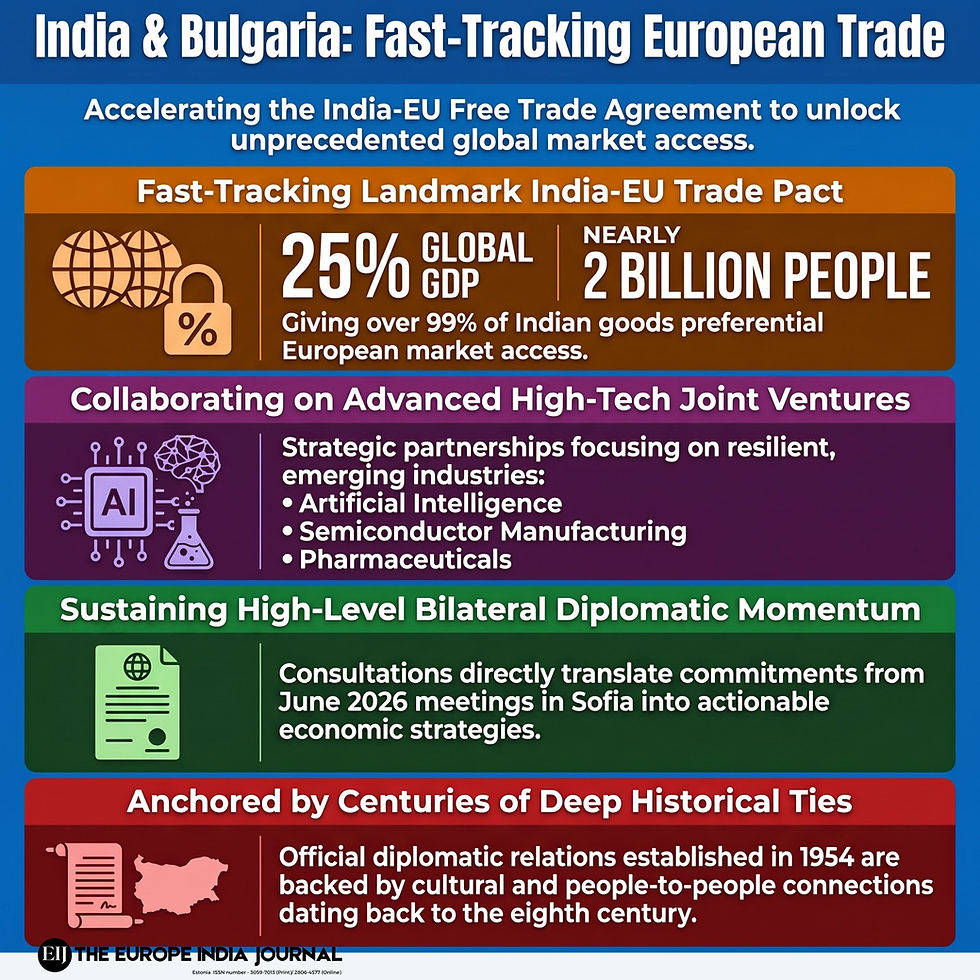
On October 1, 2026, India and Bulgaria took a major step toward tighter economic ties by holding their seventh round of Foreign Office Consultations in New Delhi. Co-chaired by Sibi George, Secretary (West) in India's Ministry of External Affairs, and Christo Polendakov, Bulgaria's Deputy Minister of Foreign Affairs, the talks aimed straight at future growth.
The discussions zeroed in on boosting bilateral cooperation in tech and the economy, but the standout goal was clear: speeding up the long-awaited India-European Union Free Trade Agreement. This high-level push highlights a serious drive to link India’s booming economy with the massive European market, setting the stage for mutual benefits.
Driving the European Trade Pact
India’s Ministry of External Affairs formally views Bulgaria as a highly valued partner within the European Union. Because of this strategic spot, Bulgaria's backing remains a major asset in making India's economic integration with Europe much smoother. During the New Delhi talks, both sides stressed that getting the free trade pact up and running early would fundamentally change and deepen their economic relationship.
The European Commission has already noted the massive scope of this deal. Officials describe it as a landmark agreement that could cut tariffs across a market of nearly two billion people and a quarter of the world’s gross domestic product. For Indian exporters, this pact offers incredible market access, with the potential for over 99 percent of goods to enter Europe under preferential tariffs. This access is expected to dramatically increase trade volumes and open new doors for businesses in both regions.
Building on Summer Momentum
The October dialogue directly builds on the diplomatic momentum sparked this past summer. In June 2026, India's External Affairs Minister, Dr S. Jaishankar, travelled to the Bulgarian capital of Sofia for crucial high-level meetings. While there, he sat down with Bulgarian leaders to look at how both nations could work closer together on academics, mobility, and cultural exchanges.
The recent consultations in New Delhi served as a platform for both countries to formally double down on these shared goals. The diplomats ensured that the promises made in June transition into real, actionable economic strategies today. This continuity shows a genuine commitment from both sides to turn diplomatic handshakes into tangible results.
Focus on Tech and Modern Industry
Looking beyond the broader European trade ambitions, the representatives spent considerable time on specific opportunities to grow their bilateral work in emerging, technology-intensive sectors. Officials from both countries took a hard look at potential joint ventures that fit the needs of modern, resilient economies.
Previous diplomatic meetings between the two nations have repeatedly highlighted the huge potential for closer teamwork in advanced fields. These include pharmaceuticals, semiconductor manufacturing, and artificial intelligence. Furthermore, the conversation naturally expanded to include multilateral collaboration, as the diplomats exchanged views on pressing regional and global developments. By getting on the same page, India and Bulgaria aim to ensure their shared interests are protected on the world stage.
Deep Historical Ties
While today's focus is heavily on future-facing economic and technological integration, the strategic partnership between India and Bulgaria rests on a solid foundation of historical and cultural connections. People-to-people contacts between the regions stretch all the way back to the eighth century, long before they formally set up diplomatic relations in 1954.
Both countries continue to take great pride in this shared cultural heritage, which fuels the warm and friendly nature of their modern relationship. To keep this positive momentum going and ensure they stay on track, the two delegations have already agreed to hold the next round of Foreign Office Consultations at a mutually convenient date in Sofia.


Comments