India–EU FTA Report: Released at the European Parliament by Members of European Parliament and Indian Parliament

The report, India–EU FTA: From Market Access to Strategic Economic Corridors, prepared by Water & Shark in association with the Europe India Centre for Business and Industry (EICBI), examines the India–European Union Free Trade Agreement as a major turning point in India–Europe economic relations. Released within the ecosystem of the EU–India Leaders Conference 2026 at the European Parliament in Brussels, the report moves beyond a narrow trade-policy interpretation of the FTA and presents it as a broader framework for business execution, investment expansion, regulatory preparedness, services mobility, supply-chain diversification and long-term institutional cooperation.
A New Perspective on the India–EU Free Trade Agreement
The central argument of the report is that the India–EU FTA should not be viewed solely as a tariff-reduction exercise. While tariff liberalisation and market access remain important components of any trade agreement, the deeper significance of the FTA lies in the commercial, regulatory and strategic architecture it can establish between two major democratic markets.
The report positions the agreement as a platform through which India and Europe can develop durable economic corridors spanning industry, technology, talent, sustainability, investment and institutional engagement. In this sense, the FTA is presented not merely as a trade instrument, but as a mechanism of economic diplomacy and long-term strategic convergence.
Why the India–EU FTA Matters in a Changing Global Economy
The report places the FTA within a rapidly evolving global trade environment. As supply chains become increasingly fragmented, geopolitically sensitive and security-conscious, both India and the European Union have strong incentives to deepen their economic partnership.
For Europe, India offers scale, talent, digital capabilities, manufacturing potential, services expertise and a pathway to diversify supply chains beyond overconcentrated geographies. For India, the European Union provides access to a high-value, standards-driven market and an opportunity to strengthen its position within global value chains.
The report therefore frames the agreement as mutually beneficial. India gains enhanced access to one of the world's most advanced economic blocs, while Europe gains a future-oriented partner in one of the world's most significant growth markets.
Beyond Tariffs: Building Long-Term Economic Corridors
A major theme of the report is the shift from market access to execution. The agreement may establish a framework, but its practical impact will depend on whether businesses, advisers and institutions are prepared to utilise it effectively.
The report emphasises that benefits will not arise automatically following the signing of the FTA.
Companies will need to prepare for rules of origin, product certification requirements, customs procedures, sustainability obligations, tax considerations, data regulations, market-entry barriers and compliance with EU standards. This is particularly relevant for Indian SMEs and mid-sized firms, which may benefit significantly from improved access to European markets but will also encounter a demanding regulatory environment.
The Expanding Role of Services, Digital Trade and Talent Mobility

The report provides a ten-year outlook on India–EU trade relations and highlights the growing importance of both goods and services. While goods trade remains significant in sectors such as pharmaceuticals, engineering products, auto components, textiles, chemicals, electronics, jewellery and processed foods, the report argues that the future of the India–EU corridor cannot be understood through goods trade alone.
Services, digital trade, professional mobility and knowledge-based industries are increasingly central to the next phase of the relationship. India's strengths in technology, professional services, fintech, SaaS, analytics and skilled talent can support European firms seeking digital transformation and cost-efficient capability-building. As a result, the FTA acquires a services and talent dimension that extends well beyond traditional trade policy.
Sectoral Opportunities Across the India–EU Economic Corridor
Rather than identifying a simple list of "winning sectors," the report presents a forward-looking opportunity matrix.
Pharmaceuticals and life sciences emerge as strategically important sectors, given India's strengths in generics, APIs, biosimilars, contract manufacturing and clinical research, alongside Europe's highly regulated healthcare market.
Engineering goods, auto components and industrial manufacturing are highlighted as areas where Indian suppliers can integrate more deeply into European value chains, provided they meet quality, testing and certification requirements.
Textiles, apparel and leather products could benefit from improved tariff access, particularly where producers combine competitiveness with sustainability, traceability and responsible sourcing practices. The report also identifies chemicals, electronics, food processing, renewable energy, fintech, professional services, higher education and mobility as sectors capable of generating long-term value through deeper India–EU cooperation.

Sustainability and Regulatory Preparedness as Competitive Advantages
The report dedicates considerable attention to sustainability and regulatory readiness. It argues that the future of India–EU trade will be shaped not only by customs duties but also by ESG compliance, carbon mechanisms, product standards, data protection frameworks, certification requirements, supply-chain transparency and labour and environmental expectations.
European regulations relating to sustainability, carbon-related mechanisms and product-level transparency requirements are expected to play a growing role in determining market access conditions for Indian businesses.
Consequently, the report advises companies to treat compliance not as a final-stage requirement, but as a core component of market-entry strategy and long-term competitiveness.
Investment as the Foundation of Long-Term Partnership
Investment is identified as another critical pillar of the future India–EU economic relationship. The report argues that investment flows will ultimately determine whether the FTA develops into a durable economic corridor or remains primarily a trade agreement. European firms entering India will need to evaluate market growth potential, state-level incentives, infrastructure quality, tax structures, labour availability, regulatory certainty and ESG expectations.
Likewise, Indian firms expanding into Europe must consider certification costs, local partnerships, corporate structures, data governance requirements, tax exposure and distribution strategies. Although the FTA can improve predictability and reduce uncertainty, businesses will still require careful planning and jurisdiction-specific structuring.
Mapping Opportunities Across Europe and India
The report also maps commercial opportunities across EU member states and Indian states. While the European Union functions as a single market, commercial opportunities continue to be influenced by national specialisations, logistics systems, regulatory ecosystems and institutional strengths. Germany is highlighted for engineering, automotive and industrial technologies; France for life sciences, premium industries and aerospace-linked supply chains; the Netherlands for logistics and distribution; Belgium for chemicals, pharmaceuticals and institutional engagement; Italy for design-led manufacturing, textiles and machinery; Ireland for technology and services; Spain for green technologies and infrastructure; Poland and Central Europe for manufacturing and logistics; and Cyprus as a strategic business bridge.
On the Indian side, the report emphasises the importance of state-level industrial capacity, investment promotion mechanisms and sector-specific strengths in translating FTA opportunities into practical outcomes.
Economic Statecraft and the Future of India–EU Relations
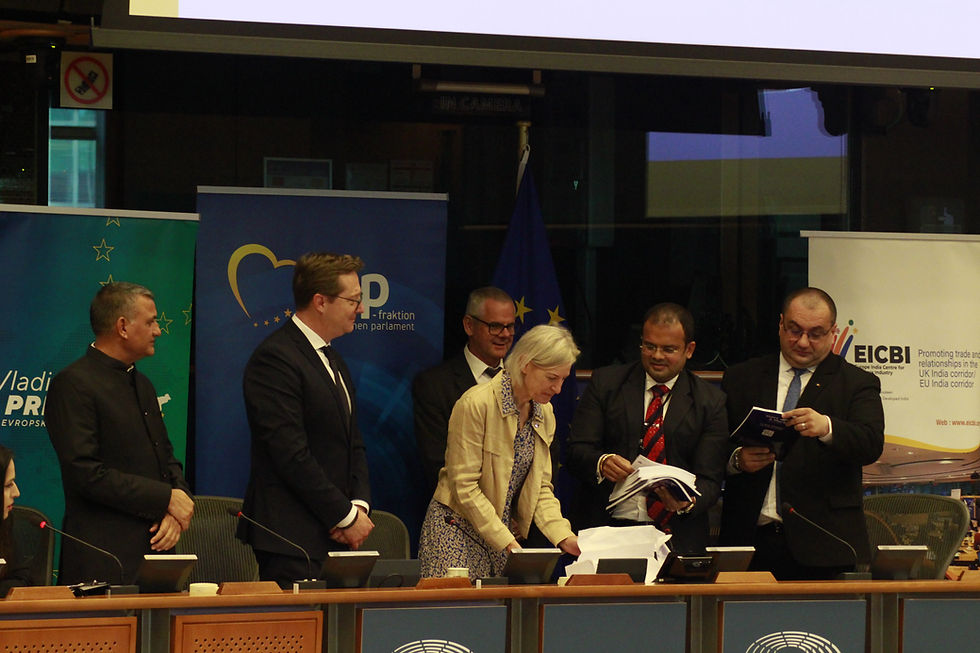
The report's overarching conclusion is that the India–EU FTA is best understood as an instrument of economic statecraft. It transforms diplomatic intent into commercial architecture and provides both sides with a framework for managing economic interdependence in an increasingly uncertain global environment. Ultimately, the success of the agreement will depend on preparedness, institutional coordination and effective execution. If implemented successfully, the FTA has the potential to become one of the defining economic bridges of the next decade, creating a corridor of trade, talent, technology and trust between India and Europe. The report was officially released at the European Parliament by MEPs - Angelika Niebler, Vladimir Prebilič, Cristian Terheș, Andreas Schieder; Indian MP - Sudhakar Singh and EICBI Chairman – Mr. Sujit S Nair.
The detailed report can be downloaded from https://www.waterandshark.com/insight/india-eu-fta-market-access-to-strategic-economic-corridors


Comments