Inside the UK–India Free Trade Agreement: A Sector-by-Sector Look at India's Export Prospects

On 15 July 2026 the UK–India Free Trade Agreement (CETA) came into effect, heralding deeper economic ties between the two countries. Under this pact, over 99% of India’s exports to the UK will enter duty-free, covering virtually the entire value of bilateral trade.
The deal builds on robust existing commerce – roughly $60 billion annually in total trade – and aims to double that by 2030. By slashing tariffs and simplifying procedures, the agreement is set to boost growth on both sides (UK forecasts estimate up to a £25.5 billion annual increase in trade and nearly £5 billion added GDP for each economy). This article highlights how key industries on each side stand to benefit.

Agriculture and Plantation Exports
India’s farmers and food processors win big under the deal. The agriculture sector (1,437 tariff lines, 14.8% of India’s trade items) and food processing (985 lines, 10.1%) now enjoy zero-duty access to the UK. Indian farm exports were already $45.05 billion in 2022–23, and analysts expect this to surge: the pact is projected to raise agri and processed-food exports by over 50% within three years.
Britain is a high-value market for niche Indian produce – from tea, mangoes and grapes to spices and marine products – often commanding premium prices. By removing India’s previous tariff disadvantage, exporters can now compete on equal terms with rivals.
For context, the UK currently imports $37.5 billion of agricultural goods yearly but only $811 million of them from India, signalling vast room for growth. In sectors like nuts, sauces and vegetable preparations, India expects to outcompete many traditional suppliers (e.g. gaining on US and China) by virtue of the new duty-free access.
India’s plantation crops also gain a foothold. Coffee, tea and spice exports (previously 2–6% tariffs) now enter the UK untaxed, making Indian value-added products more competitive. For example, UK importers of instant coffee (mainly served by European suppliers) will now face equally-priced Indian offerings. Similarly, Indian tea blends and premium spices stand to gain from tariff parity with competitors. Industry observers note that the UK market already absorbs 5.6% of India’s tea and 2.9% of its spice exports; with the FTA these volumes could climb rapidly as prices fall.
Marine Products and Fisheries
Indian fishers and seafood processors are set to benefit too. In 2022–23 India exported $8.09 billion of marine products (shrimp, fish, cuttlefish etc.). The UK – with a large Indian diaspora and strong demand for frozen seafood – is a key market.
Under CETA all remaining UK duties on Indian seafood are removed, improving price realisation for exporters and farmers. Coastal states like Kerala, Gujarat and Tamil Nadu stand to gain from higher procurement rates as products fetch better prices abroad. Currently, India supplies only about 2.25% of the UK’s $5.4 billion seafood imports, indicating an “untapped” opportunity.
With UK tariffs on shrimp and whitefish (4–8.5%) eliminated, industry forecasts point to double-digit growth in exports. Value-added segments (processed shrimp, ready-to-cook fishmeal) are also poised to expand, as evidenced by a 3.5% rise in such exports in FY2024–25 even before the deal. In sum, experts say the FTA could “double capacity utilisation” in seafood processing by boosting UK orders.
Textiles and Clothing
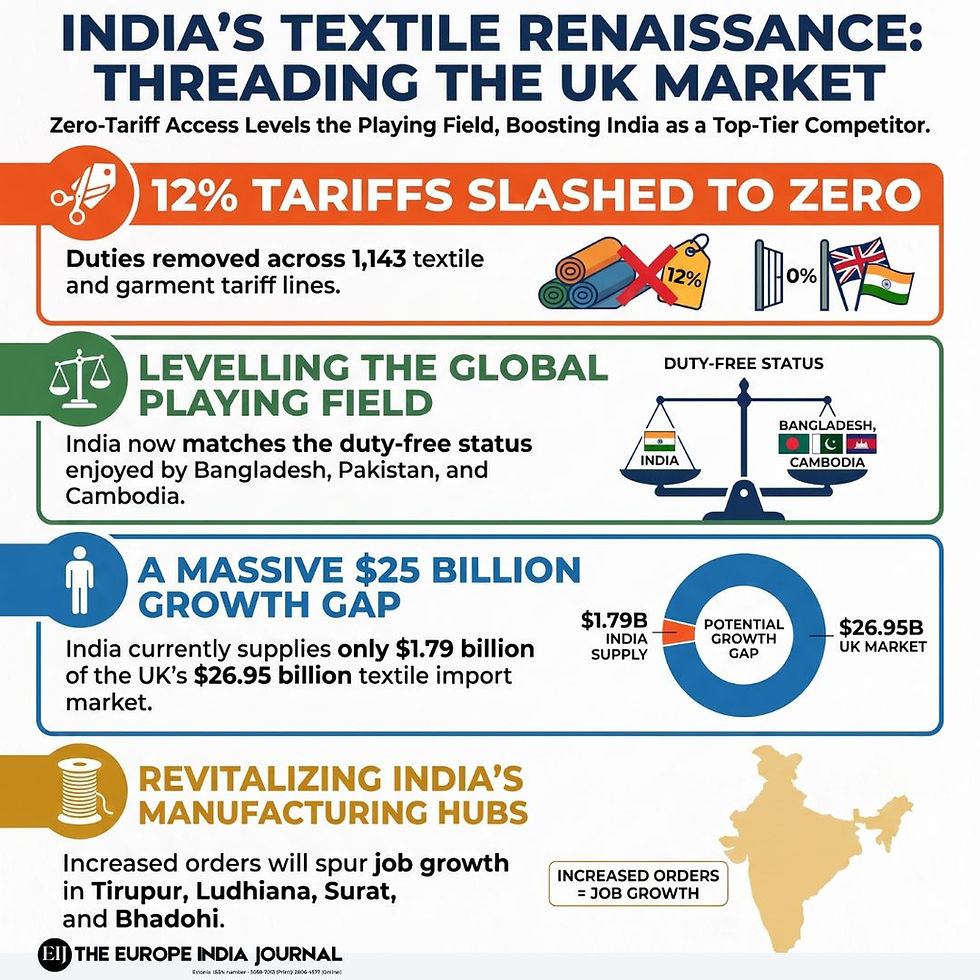
The textile and apparel industry will see a dramatic shift. Indian fabrics and garments (1,143 tariff lines, 11.7% of the total) now enter Britain duty-free, down from up to 12% previously. This removes a longstanding handicap: nations like Bangladesh, Pakistan and Cambodia had already enjoyed zero tariffs on clothing, putting India at a disadvantage. With the FTA eliminating all textile duties on Indian exports, India’s competitiveness rises sharply.
The numbers underscore the opportunity: UK consumers bought $26.95 billion of textile imports recently, while India’s worldwide textile exports were $36.71 billion – yet only $1.79 billion of that went to the UK. CETA aims to bridge this gap. Analysts expect surging demand particularly in garments, home textiles, carpets and handicrafts, where duty removal yields “immediate and substantial” advantages.
India is already the UK’s fourth-largest textile supplier (6.1% market share) and will now be better positioned to challenge top exporters like China and Bangladesh. Major manufacturing hubs – Tirupur (knitwear), Ludhiana (hosiery), Surat (fabrics), Bhadohi (carpets) – should see renewed orders, spurring job growth in these states.
Leather and Footwear
India’s leather industry will enjoy a near-free pass into the UK. Currently Indian shoes and leather goods (together over $5 billion in exports) faced tariffs up to 16%. The new deal grants 0% duty on all leather, fur and footwear exports from India. That opens an £8.5 billion UK market entirely to Indian suppliers.
Projections are bullish: India could capture at least 5% more share of UK footwear/handbag imports within a year or two. Conservatively, exports could rise from the current $440 million to over $900 million, a “substantial leap forward”.
Longer-term, India aims to become one of the top three global suppliers to the UK in this segment. Key manufacturing regions – Uttar Pradesh (shoemaking), Tamil Nadu (leather), West Bengal (hides) – are expected to see significant benefits, as local exporters use the tariff cuts to underprice rivals like Vietnam and Cambodia in Britain’s value-conscious market.

Engineering Goods and Machinery
Heavy industry exporters stand to gain as well. The engineering and machinery sector alone covers 1,659 tariff lines (17.0% of all items). The UK is already India’s sixth-largest market for engineering goods, and trade grew 11.7% in 2024–25. Yet there is a huge gap: India shipped $77.79 billion of machinery and vehicles worldwide recently, while the UK imported $193.52 billion of such products – only $4.28 billion of which came from India.
With most tariffs (up to 18%) removed, official analysis sees Indian exports to the UK nearly doubling in five years to over $7.5 billion by 2029–30. This boost aligns with India’s broader target of $300 billion in engineering exports by 2030, cementing the UK as a critical partner.
In practical terms, zero tariffs on parts and machinery will help India’s many small and medium firms – for example, metal fabricators and auto-component makers – offer more competitive pricing. It should also spur supply-chain integration in growth areas like renewable energy equipment, automotive electronics and aerospace. Companies from steelmakers to precision tool builders will find a more level playing field, since intermediate inputs like machinery now face no duty.
Electronics, Telecom and IT Services
India’s tech and electronics sectors get a big push. Tariffs on Indian electronic goods (TVs, monitors, telecom equipment, inverters, etc.) are eliminated. The UK is already India’s 4th-largest market for electronics; British imports in this category surged 25% in 2024–25 to $78 billion.
Industry notes that Indian producers are now vying with global leaders (the US, China) on equal terms. With the FTA in place, Indian electronics exports to the UK are forecast to roughly double to $4 billion by 2030. Meanwhile, the agreement facilitates trade in software and IT-enabled services. UK commitments are unusually ambitious – enabling projected 15–20% annual growth of Indian software exports by opening key markets.
The deal even allows up to 1,800 Indian chefs, yoga instructors and classical musicians to work in the UK each year under agreed categories. In addition, the UK will recognize Indian testing and certification for electronics and telecom goods, reducing technical hurdles. Overall, India’s rapidly expanding digital economy and IT sector will find clearer paths to UK customers, while British tech firms also gain access to India’s billion-strong market.

Pharmaceuticals and Medical Equipment
The pharma industry sees immediate tariff relief on almost all products. Medicines and health preparations (56 tariff lines in total) will enter Britain duty-free. This is a big opportunity: India ships about $23.31 billion of pharmaceuticals globally, yet only $1 billion of that reaches the UK, which buys nearly $30 billion worth of drugs. Analysts expect Indian generics – where India is already Europe’s top supplier – to become even more competitive.
All major antibiotic, antiseptic, and vaccine categories face no duty, likely boosting Indian exports of generic medicines. Medical devices (like surgical instruments, diagnostic machines, ECG/X-ray equipment) are also fully liberalised: current MFN tariffs (2–6%) will be cut to zero. For India’s med-tech firms this is game-changing. India’s global medical device exports (~$2.2 billion) are small relative to demand, and current UK-bound shipments were only $37 million.
The UK’s medical devices market (estimated $32 billion in 2024, rising to ~$69 billion by 2035) offers vast scope. With zero tariffs and mutual recognition of Indian certification standards built into the pact, Indian manufacturers of surgical tools and diagnostics will find it easier to sell in the UK. In short, Britain’s move away from some Chinese suppliers (post-Brexit) positions Indian pharma and device makers as attractive alternatives at a lower cost.
Chemicals, Plastics and Other Goods
Broad industrial sectors gain wide access. For chemicals (fertilisers, petrochemicals, industrial chemicals), 1,206 tariff lines (12.4%) are now duty-free. UK import data shows a $28.35 billion market for chemicals, where India had little presence (UK buys mostly from the US, China, Germany, France). The FTA therefore “positions India as a competitive, reliable supplier” and is expected to boost Indian chemical exports by around 30–40% (to roughly $650–750 million annually). Plastics (sheets, packaging, pipes, etc.) also benefit.
India is already a significant global plastics manufacturer; UK purchases of Indian plastic goods were about $0.51 billion in FY2024–25. With duty-free entry, exports in this category are projected to rise to about $0.8 billion over the next three years. Lower costs will let Indian suppliers better compete against major European sources (Germany, Belgium, Netherlands) and meet rising British demand.
Other manufacturing niches see gains too. Sports equipment and toys (soccer balls, cricket gear, etc.) are now cheaper in the UK, giving Indian producers a competitive edge over non-FTA suppliers like China or Vietnam. Projections suggest about 15% growth in exports of sports goods (with targets near $187 million by 2030) under the new deal. Similarly, smaller labour-intensive industries (rubber products, light engineering) will see incremental exports rise thanks to easier market access and lower tariffs.
Iron and steel products are fully liberalised as well. All remaining duties (formerly up to 10%) on Indian iron/steel exports to the UK are eliminated. The UK’s steel import market (~$18.5 billion annual demand) is now accessible to India’s mills and forges. Currently India supplies only about $887 million (4.8%) of UK steel needs, so even modest gains could significantly raise exports. Industry experts note that capturing just a third of the UK’s global import share could send Indian steel exports toward a multi-billion-dollar target, helping India’s ferro-based MSMEs at home.

Gems, Jewellery and Handicrafts
Tariffs in the gems and jewellery sector are also scrapped. Indian shipments of diamonds, gold and craft jewellery (total $941 million in recent years) will enter the UK at 0% duty. The UK imports around $3 billion of jewellery annually, so there is room for India to grow far beyond current levels. Experts estimate that Indian gems and jewellery exports to Britain could roughly double within 2–3 years under the agreement.
This boost will directly support India’s artisan communities and small craftsmen. For example, Rajasthan and Gujarat stone-cutters, as well as jewellery hubs like Mumbai and Delhi, expect new orders. Increased UK demand and reduced costs are seen as reviving traditional trades and creating jobs in rural areas tied to the jewellery value chain.
Services and Professional Mobility
Services, a core strength of both economies, see comprehensive new market access. India’s service sector (about 55% of GDP) already runs roughly a $6.6 billion surplus with the UK (exports $19.8bn vs imports $13.2bn in 2023). Under CETA, the UK has offered one of its most ambitious services packages, covering all 12 service sectors and 137 sub-sectors (over 99% of India’s export interests). Key areas like information technology, financial and professional services, education and healthcare are included. UK commitments in digitally delivered services in particular will help Indian IT firms expand their presence. Both countries also set clear rules for temporary movement of business professionals – from intra-corporate transferees to independent consultants – easing travel and visa processes.
A landmark feature is social security portability. The agreement’s Double Contribution Convention (DCC) means that professionals on assignment in the other country pay social security in only one place. The UK extended this exemption from 36 to 60 months. In practice, a young Indian engineer in London or a British consultant in Mumbai won’t have to make “double contributions” to both systems for up to five years. The governments estimate this will save Indian companies and workers more than ₹4,000 crore (around £400 million) in the coming years. In short, mobility of talent is facilitated alongside goods: simultaneous with the FTA, about 3,000 two-year work visas for young professionals will be granted annually to each country, and long-term migration benefits are secured for skilled workers.
In summary, official analyses from both sides agree that the UK–India CETA opens unprecedented opportunities across diverse sectors. By phasing in tariff cuts and modernising trade rules, the agreement is designed to boost jobs and growth – from farmers and factory workers to IT specialists and jewellers – without compromising sensitive domestic industries. All the data above come from government sources and trade reports, ensuring a fact-based picture of the sectoral gains.


Comments