Why CBAM Should Not Define India-EU Relations: Balancing Climate Ambition with Strategic Partnership

The European Union's Carbon Border Adjustment Mechanism (CBAM), set for full implementation from 2026, has emerged as a defining issue at the ongoing COP30 climate conference in Belém, Brazil. While the mechanism aims to align international trade with climate objectives, its implications for developing economies have prompted calls for dialogue and cooperative solutions that preserve both climate ambition and economic partnership.

The mechanism will impose border tariffs on carbon-intensive goods, including iron, steel, aluminium, and cement, entering the EU. For many developing economies, these sectors represent significant export revenue and employment opportunities. India, for instance, exports approximately USD 8 billion worth of CBAM-covered goods to the EU annually, with steel and aluminium accounting for substantial portions of this trade.
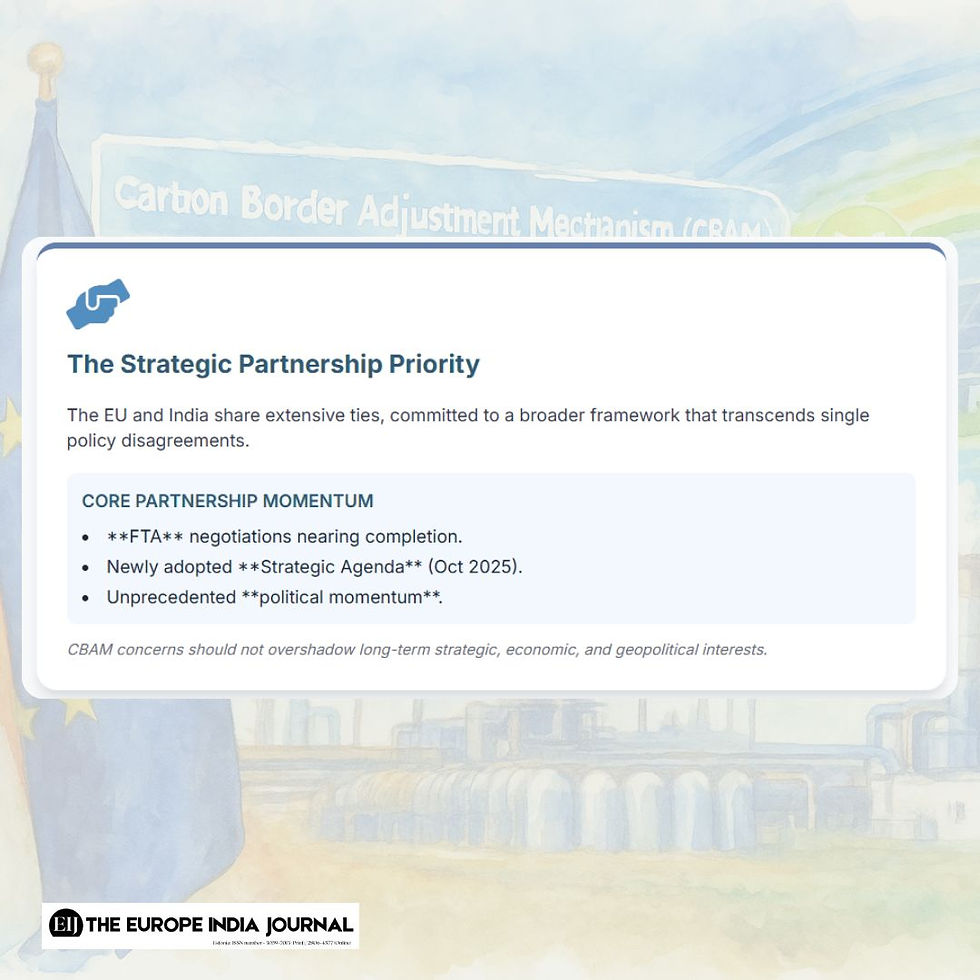
These concerns reflect broader anxieties across developing countries in Africa, Asia, and Latin America regarding CBAM's potential economic impact. However, the EU and India stand at a critical juncture in their bilateral relationship. With Free Trade Agreement (FTA) negotiations nearing completion, a newly adopted Strategic Agenda, and unprecedented political momentum, allowing policy disagreements to undermine decades of partnership building would be shortsighted for both sides.
A Legitimate Concern, But Not a Partnership Breaker
The concerns regarding CBAM are legitimate and deserve attention. However, allowing this single policy measure to strain broader strategic, economic, and geopolitical ties would be counterproductive for both sides. India has already demonstrated pragmatism in addressing this issue. During November negotiations, Commerce Secretary Rajesh Agrawal emphasized the need for clarity and predictability in the implementation of emerging EU regulatory measures, including CBAM. This approach reflects India's commitment to resolving concerns through dialogue rather than confrontation, seeking solutions that accommodate both climate objectives and development imperatives.

Understanding Global South Demands
The Global South faces significant challenges that extend beyond CBAM. Climate finance remains a key barrier to raising ambition on climate action. Developing countries have called for three critical measures: strengthened public finance flows specifically for adaptation, clear definitions of what qualifies as climate finance, and full implementation of Article 9.1 of the Paris Agreement (which legally obligates developed countries to provide financial support to developing nations).
The challenge is stark. At COP30, developing countries noted that adaptation financing needs exceed current flows by nearly fifteen times. This means billions of vulnerable people in developing countries, who have contributed least to global warming but face the greatest climate impacts, lack adequate resources to build resilience and adapt to climate change.
The EU has already acknowledged this concern. It has expressed commitment to supporting developing countries in implementing CBAM and transitioning to renewable energy sources. Sweden's State Secretary for Environment and Climate confirmed willingness to help India develop more sustainable industrial models to address CBAM requirements. Such constructive engagement demonstrates that disagreement on policy approach need not prevent collaborative problem-solving.
A Comprehensive Strategic Framework Beyond CBAM
The EU and India adopted a New Strategic Agenda in October 2025, identifying five priority pillars for cooperation: prosperity and sustainability, technology and innovation, security and defence, connectivity, and enabling frameworks. This comprehensive framework reflects both parties' recognition that their partnership extends far beyond individual policy disagreements.
The FTA negotiations represent a historic opportunity. Both sides have acknowledged substantive progress across several negotiating areas and committed to sustaining momentum toward completion. The bilateral relationship encompasses trade in goods and services, investment, technology cooperation, defence collaboration, and shared commitment to multilateralism, all areas where dialogue and partnership remain essential. Allowing CBAM concerns to overshadow these negotiations would mean missing an opportunity that serves the long-term interests of both economies.

Moving Forward Through Sustained Dialogue
The path forward requires balancing legitimate climate ambitions with equitable development objectives. India has demonstrated readiness to collaborate with other nations to implement climate solutions in ways that are ambitious, inclusive, fair, and equitable, based on the principles of common but differentiated responsibilities (CBDR-RC) and national circumstances.
As both the EU and India navigate complex climate and trade issues, maintaining dialogue and mutual respect will be essential. Climate policies should strengthen, not strain, strategic partnerships that serve broader global interests. The current moment calls for both sides to demonstrate that mature strategic relationships can address policy disagreements constructively while maintaining the momentum on cooperation that benefits both economies and contributes to a more stable, rules-based international order.


Comments