Europe and India Team Up to Turn Battery Waste into Valuable Resources


The European Commission recently released a draft rule that could change how we view the global electric vehicle and energy storage markets. Published in August 2026, this update outlines exactly how to calculate, verify, and document the recycled materials used in sustainable batteries.
Stemming from the broader EU Battery Regulation, it sets up a strict system to measure how much cobalt, lithium, nickel, and lead is recovered from old batteries and put back into new ones. For manufacturers and policymakers pushing for a circular economy, this moves green goals from mere ideas into legally binding rules. Interestingly, the EU-India battery circularity roadmap reflects a shared push to strengthen clean energy and sustainable supply chains across both regions.
Tracking Critical Minerals
The draft rules focus mainly on industrial batteries over 2 kWh, as well as those used in electric vehicles and smaller transport like e-bikes. Manufacturers now have to calculate the recycled content for every battery model, tying the data to the specific year and facility where it was made.
To keep the data honest, the European Union is using a strict tracking method. This means companies need a solid digital paper trail to follow materials from the moment they enter a recycling plant until they are built into a new battery. They also have to hold onto these records for at least a decade so auditors can double-check the numbers.
Upcoming Recycling Targets
While the immediate goal is to accurately report these recycled shares by August 2028, this rule is setting the stage for strict minimum requirements.
Fast forward to August 2031, and batteries sold in Europe will need to contain at least 16 percent recovered cobalt, 85 percent lead, 6 percent lithium, and 6 percent nickel.
These targets will jump even higher by 2036, pushing the industry away from relying solely on newly mined materials. By laying out these targets years in advance, Europe is prompting the whole supply chain to adapt quickly, ensuring a steady market for high-quality recycled battery materials.
The India-EU Partnership
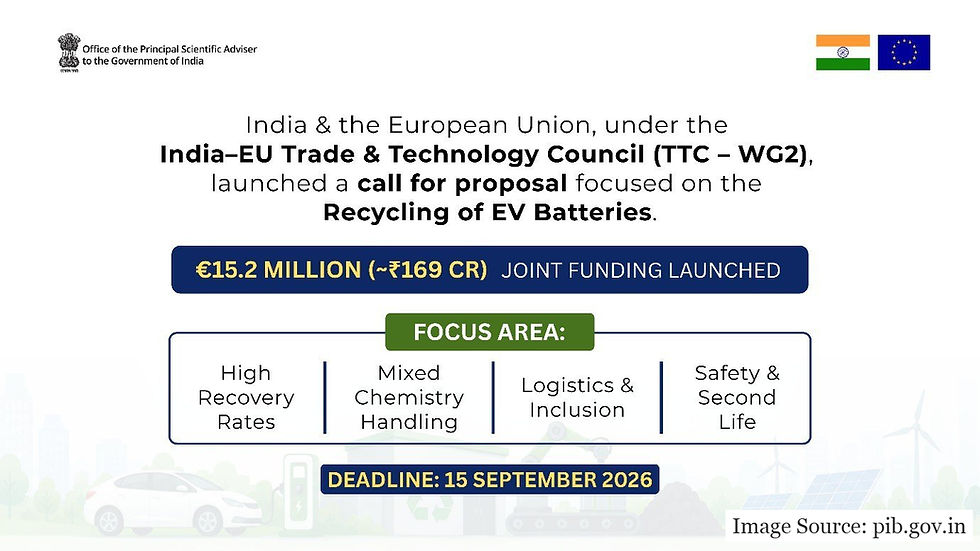
Europe's legislative push perfectly matches what is happening in India, creating a strong opportunity for teamwork. Knowing that the shift to green energy relies heavily on having enough critical minerals, the India-EU Trade and Technology Council recently kicked off a joint effort to improve battery recycling.
Announced in May 2026 with €15.2 million in combined funding, this programme is a major investment in the circular economy. It aims to improve how we recover materials, safely handle mixed battery types, and build digital collection systems. Backed by the EU’s Horizon Europe programme and India’s Ministry of Heavy Industries, the goal is to lock down critical raw materials for both regions.
Aligning the Rules
The EU’s rules for recycled content actually mirror the ideas behind India’s Battery Waste Management Rules of 2022. India’s framework holds producers responsible for the end-of-life of their products, strictly banning battery disposal in landfills and incinerators.
On top of that, Indian rules require new batteries to use a minimum amount of domestically recycled materials starting in the 2027-2028 financial year. By getting on the same page, both regions are working to turn battery waste from a massive environmental problem into a highly valuable resource. Europe's precise calculation methods help ensure these recycling claims are real, which supports India's goal of building an inclusive system that brings together both formal and informal recycling workers safely.
Building a Clean Energy Future
A big part of this collaboration is building a shared pilot facility in India, aimed at taking new recycling technologies out of the lab and into real-world factories. With electric vehicles becoming more popular every day, securing a steady supply of these critical minerals is a top priority for both economies.
The joint work under the Trade and Technology Council gives start-ups, researchers, and industries a chance to create scalable recycling methods together. Ultimately, Europe’s new verification rules provide the technical backing needed to make these shared goals possible, ensuring the vital materials of tomorrow stay in circulation within a cooperative global economy.


Comments