Germany: How Munich, Stuttgart & Wolfsburg Power India’s Industrial Engine

Updated: Feb 12
Germany’s manufacturing heartland is emerging as a key partner in India’s bid to scale up advanced manufacturing, diversify supply chains and plug more deeply into European value chains. Munich, Stuttgart and Wolfsburg sit at the centre of this shift, linking India to Germany’s strengths in automotive engineering, machinery, mobility software and industrial innovation. As India and the European Union move toward implementing their new free trade agreement, these cities are poised to play an even more visible role in powering India’s industrial engine.
Why Germany – And These Cities – Matter To India
Germany is India’s largest trading partner in Europe, with bilateral goods trade hovering around the EUR 30 billion mark in recent years and showing steady growth.
German exports to India reached more than 18 billion US dollars in 2024, while Indian exports to Germany exceeded 10 billion US dollars, reflecting a broad-based partnership in machinery, automobiles, chemicals, pharmaceuticals and IT services.
Three trends make Munich, Stuttgart and Wolfsburg particularly relevant for India today:
A dense concentration of automotive and engineering champions that already source from, manufacture in or run R&D centres in India.
Strong state-level ties, especially between India and Bavaria (Munich) and Baden‑Württemberg (Stuttgart), where hundreds of Indo‑German business relationships and joint ventures are active.
A shared political push from Berlin and New Delhi to expand investment both ways, diversify supply chains and leverage SMEs and startups in future-oriented sectors like AI, green mobility and clean energy.
With the India–EU trade deal now concluded, leaders from both sides have underlined that the agreement should inject additional momentum into German‑Indian economic relations and make these city hubs even more central to two‑way trade.

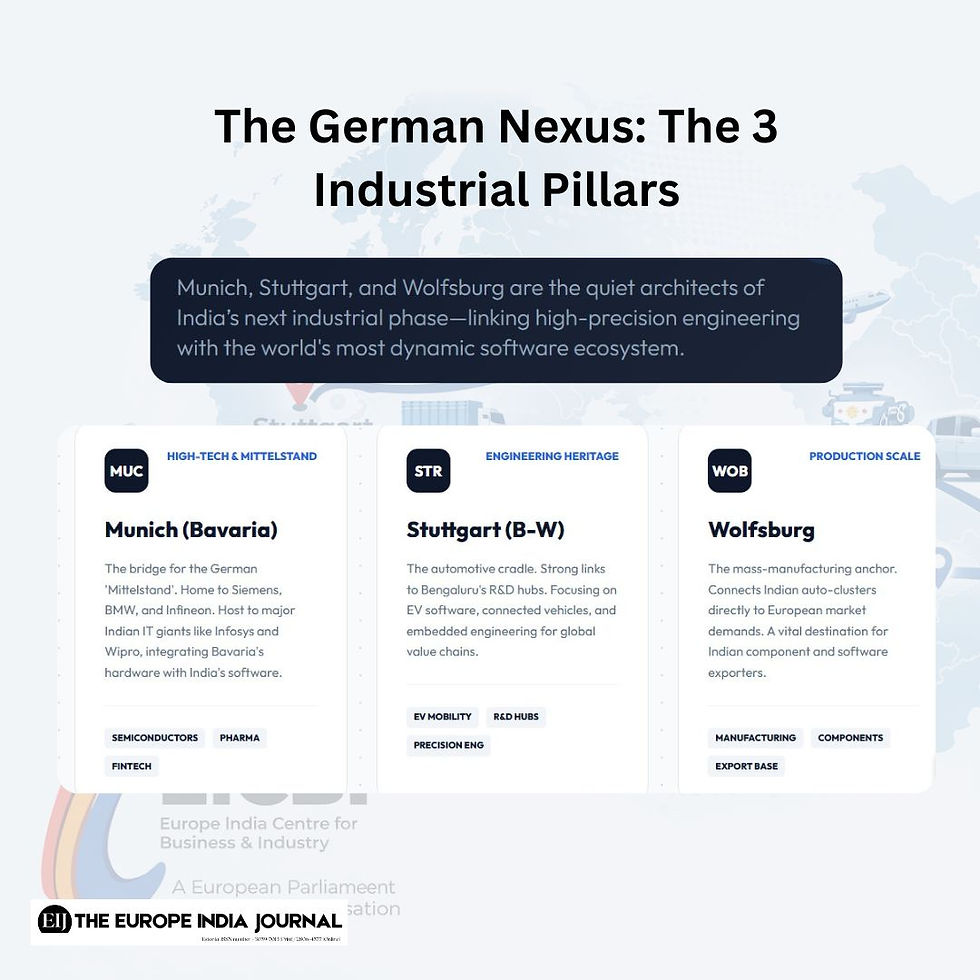
Munich: Gateway For Mittelstand And High-Tech
Munich, capital of Bavaria, has become a major European base for Indian companies in IT, automotive, electrical equipment and pharmaceuticals. Firms such as Infosys, Wipro, TCS, HCL, Mahindra Group and several Indian pharma companies maintain operations in Bavaria, using Munich’s ecosystem as a bridge to German and wider EU clients.
From the German side, more than 350 Bavarian companies have ventures in India, including Siemens, BMW, Audi, MAN, Allianz, Munich Re, Infineon and Linde. These companies export advanced machinery, automotive components, industrial gases, insurance and financial services, and engineering solutions to India, while increasingly sourcing software, back‑office services and manufactured components from Indian locations.
Events hosted by the Consulate General of India in Munich for Mittelstand firms underline the message that India is positioned as a key destination for German SMEs seeking manufacturing and investment opportunities.

Stuttgart: Engineering Heritage, Bengaluru Link
Stuttgart, the capital of Baden‑Württemberg, is home to some of the world’s most recognisable automotive and engineering brands and suppliers. German auto majors connected to the Stuttgart region have built a significant presence in India through manufacturing plants, R&D centres and Global Capability Centres, with Bengaluru emerging as a preferred hub for software and mobility innovation.
These centres support areas such as EV software, battery systems, connected‑vehicle platforms and embedded engineering, allowing German firms to pair Stuttgart’s engineering heritage with Indian digital talent and cost‑competitive manufacturing. For India, this translates into high‑quality jobs in design and software, deeper integration into global automotive value chains and access to advanced technologies that support its own EV and mobility transition.

Wolfsburg: Automotive Hub Linking To Indian Manufacturing
Wolfsburg, best known as the headquarters of a major German automotive group, anchors one of Europe’s largest vehicle manufacturing clusters. Over time, this group and its associated suppliers have developed a footprint in India through local production, component sourcing and engineering services, connecting Indian auto clusters to European markets.
While corporate strategies on specific product lines can evolve, India continues to feature in long‑term plans as a manufacturing, engineering and export base within a global portfolio. For Indian suppliers, Wolfsburg’s ecosystem represents an important demand centre for components, software and engineering services that feed into vehicles sold across Europe and other regions.

How The Supply Chain Actually Flows
Across these three hubs, the broad supply chain logic connecting Germany and India can be described in simple steps:
Raw materials and components
German companies source raw materials and semi‑finished goods globally, including metals, chemicals and electronics, combining these with in‑house design and engineering.
Indian firms, in turn, supply machinery, auto components, software, IT services and pharmaceuticals into German production and service chains.
Port and logistics corridors
Goods move between Germany and India mainly via European ports such as Hamburg and others connected to German industrial regions, and major Indian ports that serve manufacturing hubs and export clusters.
Containerised flows carry everything from engineering equipment and vehicles to textiles, chemicals and consumer goods, often as part of multi‑country value chains.
Shipping to Indian industry
German machinery, industrial equipment and vehicles shipped from hubs linked to Munich, Stuttgart and Wolfsburg are deployed in Indian factories, logistics networks and urban transport systems.
Indian exports – including machinery, auto components, IT‑enabled services and pharmaceuticals – are used by German manufacturers and service providers, feeding back into European production and distribution networks.
This two‑way flow underpins a growing share of India–EU trade, with Germany acting as a key industrial anchor within that relationship.

Why It Matters Now: FTA, De-Risking And Sustainability
Indian and German leaders have repeatedly highlighted supply chain diversification, resilience and innovation as shared priorities. Their most recent joint statement welcomed strong two‑way investments and underlined the role of SMEs, startups, digitalisation and AI in driving the next phase of economic cooperation. Both sides have also reiterated support for implementing the India–EU Free Trade Agreement as a central outcome of the new strategic phase in relations.
For European policymakers, “de‑risking” from concentrated dependencies – including in relation to China – and building resilient, diversified supply chains has become a core objective.
This is matched by India’s own interest in positioning itself as a reliable partner for global manufacturing, green technologies and digital services. At the same time, the EU’s climate‑related trade instruments, including the Carbon Border Adjustment Mechanism, are reshaping how companies organise their supply chains and emissions reporting.
In this context, links between India and the German industrial hubs of Munich, Stuttgart and Wolfsburg allow both sides to align economic growth with resilience and sustainability goals. Trade in machinery, clean mobility solutions, industrial equipment and advanced services gives India access to European technology, while giving German firms a strong partner in Asia for scaling production and innovation under evolving regulatory frameworks.
These are not just cities on a map – they are quiet engines of India’s economic connectivity with Europe, translating high‑level political intent into everyday trade, investment and industrial collaboration on the ground.
Note: This article launches EIJ’s European Union–India Supply Chain Series, spotlighting the EU member states, cities, and companies shaping India’s trade networks. Each week, we will examine one EU country’s strategic role across industrial goods, logistics, advanced manufacturing, retail sourcing, innovation, and critical intermediates. Over the coming weeks, the series will map the infrastructure that quietly powers EU–India commerce. Stay with us as we trace the supply routes connecting the European Union and India — one member state at a time.


Comments