India-EU FTA Readiness Takes Centre Stage as Experts Examine Role of States at National Policy Roundtable on Fiscal Federalism

New Delhi, 6 October 2026: As India and the European Union move towards implementing their Free Trade Agreement (FTA), policymakers, academics, trade experts and business representatives have turned attention to a critical question: how prepared are India’s states to convert national-level trade commitments into investment, exports and economic growth?
The question formed the focus of the National Policy Roundtable on “Fiscal Federalism and India-EU FTA Readiness”, which brought together Indian and European perspectives across three substantive sessions covering institutional and fiscal preparedness, state capabilities and the practical requirements of businesses.

The discussions examined how the effectiveness of the India-EU FTA will depend not only on tariff concessions but also on the capacity of states to support businesses through infrastructure, regulatory coordination, standards and certification, skills, sustainability measures and resilient supply chains.
The conference opened with welcome remarks by Dr. Upasana Arora, Chairperson, Services Export Promotion Council (SEPC)-India, followed by introductory remarks from Prof. Dinesh Khattar, Principal, Kirori Mal College, University of Delhi.
Context-setting remarks were delivered by Dr. Abhay Sinha, Director General, Services Export Promotion Council, while Ms. Judith Weinberger-Singh, Resident Representative, Hanns Seidel Foundation (HSS) India, and Mr. Stefan Burkhardt, Head of Division, South and Southeast Asia, Hanns Seidel Foundation, Germany, brought institutional and European perspectives to the opening discussion. Ms. Sonia Prashar, Secretary General, Federation of European Business in India, also addressed the gathering.
The opening session featured a keynote address by H.E. Ambassador Jean-Eric Paquet, Delegation of the European Union to India and Bhutan, followed by the Guest of Honour address by Shri Saket Kumar, IAS, Joint Secretary, Europe-I, Ministry of Commerce and Industry, Government of India.
The opening discussions established the broader context for the day: with the FTA moving from negotiation towards implementation, India’s domestic institutional capacity and the coordination between different levels of government will be important in determining how effectively businesses can use the agreement.
The first substantive session, “Assessing India's Institutional and Fiscal Readiness for the India-EU FTA,” examined the institutional and fiscal architecture needed to support implementation of the agreement.

The panel brought together Prof. Rekha Saxena, Head of Department and Senior Professor, Department of Political Science, University of Delhi; Prof. Chanchal Kumar Sharma, Dean, School of Election Management, IIIDEM, Election Commission of India, Delhi; and Dr. VN Alok, Professor, Indian Institute of Public Administration, Delhi.
The session was moderated by Mr. Sujit S Nair, Chairman, Europe India Centre for Business & Industry (EICBI).
Discussions focused on the role of India’s federal structure in implementing trade commitments and on the importance of state-level fiscal and institutional capacity. While the FTA is negotiated at the national level, its economic impact will ultimately be shaped by the ability of states to provide the infrastructure, regulatory environment and institutional support required by businesses.
The session also considered the implications of public investment and fiscal arrangements for developing export-oriented economic ecosystems across states.
The second session, “Building State Capabilities for India-EU FTA Implementation: Non-Tariff Barriers, Sustainability and Resilience,” moved the discussion towards the increasingly complex requirements associated with international market access.
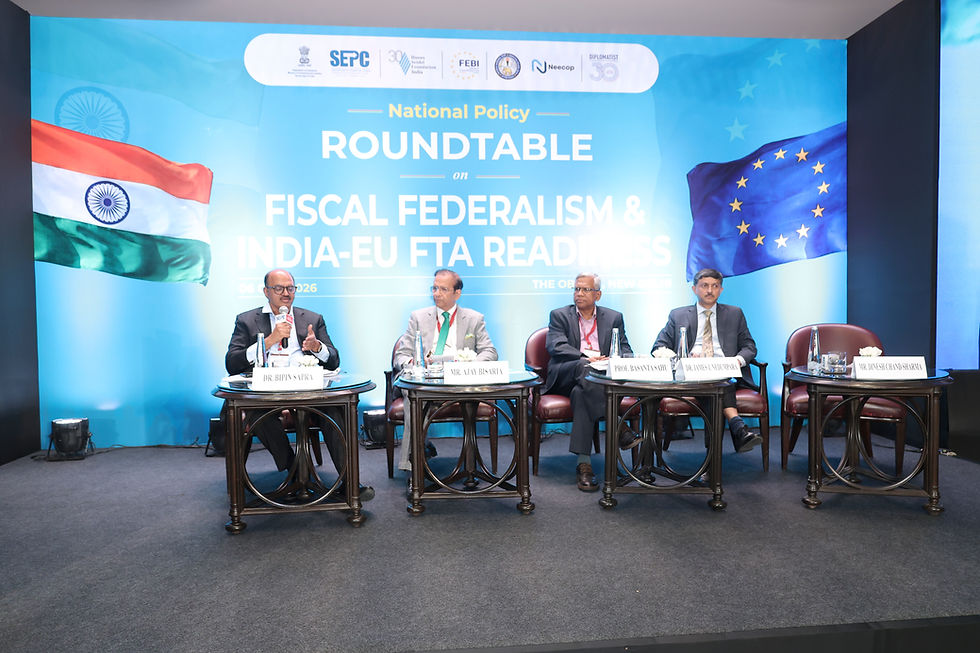
The panel featured Dr. Bipin Sapra, Partner-Leader, Indirect Tax & Economic Policy, EY; Mr. Ajay Bisaria, Corporate Strategic Advisor, Independent Director, Distinguished Fellow, ORF and former Ambassador; Dr. James J. Nedumpara, Head, IIFT-Centre for Trade and Investment Law (CTIL); and Mr. Dinesh Chand Sharma, Director, Standards and Public Policy and Seconded European Standardization Expert in India.
Prof. Basanta Sahu, Professor and Head, Economics Division, Indian Institute of Foreign Trade (IIFT), Delhi, moderated the session.
The panel examined how non-tariff measures, European standards, sustainability requirements and supply-chain resilience could affect the ability of Indian businesses to compete in the EU market. The discussion highlighted the need for stronger state-level capabilities in areas such as standards, certification, regulatory implementation and infrastructure.
With sustainability and transparency requirements becoming increasingly important in international trade, participants also considered the need for states to prepare businesses for evolving market requirements rather than treating tariff reduction as the sole measure of market access.
The third session, “From Market Access to Market Presence: What Businesses Need from States to Make the India-EU FTA Implementation Effective!”, brought the perspective of companies operating in India into the discussion. Dr. Bidisha Bhattacharya, Associate Fellow and Head-Research, Centre for Economy and Trade, Chintan Research Foundation, provided the context-setting remarks.

The business panel comprised senior representatives from European businesses in India and the FEBI membership, including Siemens Healthineers, Carlsberg, Michelin and SAP. The session was moderated by Mr. Alok Kesari, Director, Policy Advocacy and Trade Facilitation, Federation of European Business in India (FEBI). The discussion examined the practical conditions that influence whether market access results in sustained investment and commercial presence. Reliable power, land availability, regulatory approvals, logistics, skilled manpower and access to clean energy were among the broader state-level conditions relevant to business decisions.
The session reinforced the distinction between securing access to a market and creating the conditions required for businesses to establish, expand and remain competitive within it.
State Readiness Index proposed as a practical framework
Across the sessions, the need for a measurable approach to assessing state-level preparedness emerged as a central theme. Participants discussed developing an EU-India FTA State Readiness Index that could help identify where individual states are prepared to utilise FTA opportunities and where capacity gaps remain.
Such an index could assess factors including fiscal capacity, industrial competitiveness, infrastructure, regulatory efficiency, sustainability, skills, digital infrastructure and supply-chain resilience. It could also help policymakers move from broad assessments of state performance towards identifying specific constraints requiring intervention.
The conference concluded with a valedictory session addressed by Dr. Abhay Sinha, Director General, Services Export Promotion Council.
The conference seeked to assess India’s institutional and fiscal preparedness, examine state capabilities in addressing non-tariff and sustainability requirements, and identify the conditions businesses need from states for effective India-EU FTA implementation. Dr. Neha Verma, Associate Professor, KMC, and Dr. Sameer Lama, Associate Professor, KMC, served as Masters of Ceremonies.


Comments