EU–India FTA Enters Implementation Phase as Focus Shifts to Enforceable Trade Rules

The India–European Union Free Trade Agreement (FTA) has moved into a decisive implementation phase, with EU institutions and member states focusing on how the agreement concluded on 27 January 2026 will operate in practice. As legal and procedural steps advance, attention is turning to enforceability, regulatory clarity and the treatment of non-tariff barriers within the framework.

From political agreement to legal finalisation
Negotiations were formally concluded at the India–EU summit in New Delhi after nearly two decades of intermittent engagement. According to official EU trade processes, the agreement is now undergoing legal verification, followed by translation into all official EU languages and completion of internal procedures on both sides before entry into force.
In their joint statement issued during the visit of the President of the European Council to India, leaders described the agreement as a “landmark” outcome and called for progress on related areas, including investment protection and geographical indications. This stage marks a transition from negotiation to implementation within established institutional frameworks.
Emphasis on enforceability and non-tariff measures
Recent public reporting indicates that France has underlined the importance of a clear and enforceable framework as the agreement progresses. Statements attributed to French officials highlight the need to implement the FTA in practical terms, with particular attention to non-tariff barriers that can influence market access despite tariff reductions.
This approach reflects a broader EU policy emphasis on transparency, predictability and consistent application of trade rules across member states. In the context of the EU–India FTA, this includes how provisions on regulatory practices, market access and dispute settlement will function once operational.
Technical engagement on regulatory clarity
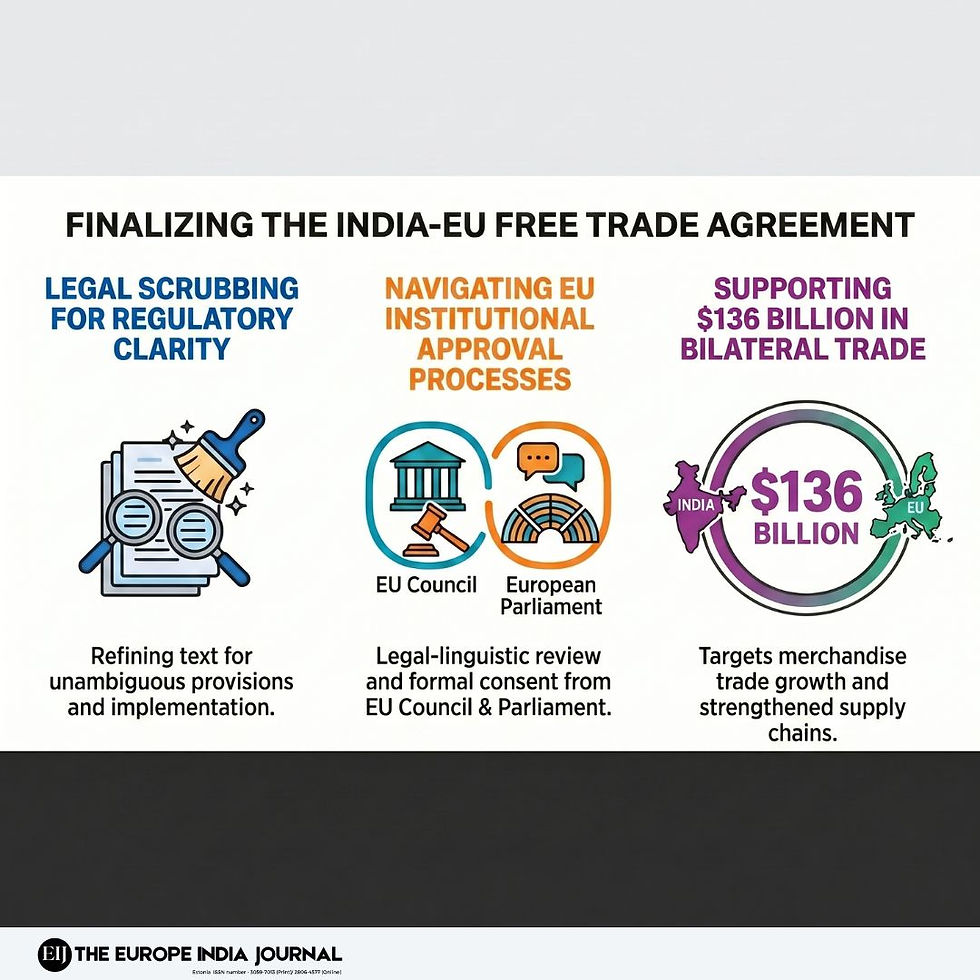
Both India and the European Union are engaged in technical-level discussions to finalise the agreement’s operational details. This includes legal “scrubbing” of the text to ensure that negotiated provisions are accurately reflected and can be implemented without ambiguity.
Key areas of focus include non-tariff measures, regulatory alignment in specific sectors and mechanisms designed to facilitate trade while preserving regulatory autonomy. These steps are standard in large-scale trade agreements and are intended to ensure clarity before implementation.
EU institutional procedures under way
Within the EU, the agreement is proceeding through a structured process involving legal-linguistic review and institutional approvals. This includes consideration by the Council of the European Union and consent by the European Parliament, in line with EU treaty requirements.
While the core terms of the agreement remain unchanged, member states may provide inputs on implementation-related aspects such as trade facilitation and regulatory cooperation. A separate instrument on investment protection is expected to follow its own ratification pathway involving member states.
Economic context and next steps
The EU remains one of India’s principal trading partners, with official data indicating bilateral merchandise trade of approximately USD 136 billion in 2024–25. The FTA is expected to support trade in goods and services, encourage investment flows and strengthen supply chains within a rules-based framework.
The current phase centres on ensuring that agreed commitments are translated into clear, enforceable provisions. Ongoing institutional and technical processes will determine the timeline for the agreement’s entry into force and its practical impact on businesses operating across both markets.


Comments